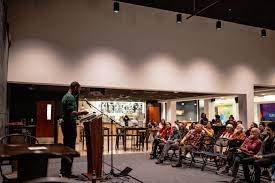
"Stage Proxemics" nominated for a Pushcart Prize

I'm honored to announce that my creative nonfiction piece “Stage Proxemics” was nominated for a Pushcart Prize by Pangyrus.

My brother is a fucking badass. Always has been. Even before he was my brother. I learned how to walk trying to keep up at Afrocentric art shows, poetry readings, dramatic performances, rallies, and protests. He taught me that Black Lives Mattered before the proto-progressives in Boston had heard of George Floyd or Rodney King. I tell people I’m on at least five government watchlists. Between lessons about IRA activities in local catholic parishes and revolutionaries smoking cigars with Fidel Castro, at least one of those lists is definitely his fault.

Two Poems in Wayfarer Magazine

"Won't you come and Celebrate with me" and "when asked to explain racism as a system of power, again" were published in Wayfarer Magazine.

"Biophobia" [creative nonfiction] published in The Manifest Station

This goes out to all of the people who enjoy being in the “Great Outdoors” and those who dig below surfaces they should really leave alone.

Biophobia” started as an exercise in a Kenyon Review Residency last summer and is now a creative nonfiction essay published in The Manifest Station.

“watching a production of The Tempest after a colleague asked about my relationship with white women” published in Terrain

My poem “watching a production of The Tempest after a colleague asked about my relationship with white women” was published in Terrain.org as part of their Letters to America series. The link includes a reading of the poem.

The poem contains research on Caliban in The Tempest from The Great White Bard: How to Love Shakespeare While Talking About Race by Farah Karim-Cooper.

A poem in The Book of Jobs anthology from One Art

My poem “when asked to read a poem for the Black History Month assembly, again” (first published in Cultural Daily) has been republished in the One Art anthology The Book of Jobs.

You can read the whole anthology on One Art through the link below. A fully accessible edition will be published by Penn State University Libraries Open Publishing in 2026.

Gloucester Writers Center reading 7/17/25

A (partial) recording of my reading with Luisa Caycedo-Kimura at the Gloucester Writers Center on July 17th, 2025. Luisa read from her wonderful new book All Were Limones while I read from a manuscript in progress.

My set list (such as it is):

  • across the table” (excerpt) [time: 2:37]

  • “What else can I say when this lady says it all so well? Just…I think of you.” [time: 3:50]

  • “midwifery” [time: 5:50]

  • “you’d get over it” [time: 7:36]

  • “Gloucester Harbor | 78 “ [time: 8:35]

"oh God! please stop!!" in South Florida Poetry Journal

My poem “oh God! please stop!!” now appears in South Florida Poetry Journal . Bonus: a recording of me reading the piece accompanies it. Trigger warning: historical, graphic racial violence.

Click on the link below and scroll down to my name.

“oh God! please stop!!”
 
from the back of the class, his cry careens
over the heads of the rest—their stricken faces, jaws slack
or furiously clenched, eyes dewy or attempting to shut out
the assailant in my words—but I refuse. continue explaining
the lynching by car of James Byrd Jr., briefly mentioned
in Rankine’s The White Card, open on their desks. the event
is presented as a turning point, character development for ‘Charles,’
a billionaire with Basquiat’s Defacement on his wall. a news story
whose horror shook him into seeing that racism still existed
in the enlightened, heady days of 1998. a details-oriented educator,
I clarify why ‘Charles’ was so troubled.
 
Byrd—49, disabled, Black—was walking home
when three white men—one he thought a friend,
had known his whole life—offered him a ride
in a grey Ford pickup. crushed between them,
they forced him to remote woods, kicked and punched
and baseball batted him in and out of consciousness,
spray painted his face blacker, pissed and shat on him,
retrieved a 24-foot-long chain from the truckbed,
noosed it about his ankles, and dragged him for 1.5 miles.
the FBI’s autopsy determined he was conscious―
trying to keep his upper-body off the road-rashing concrete―
until their carefree swerving swung him into a culvert,
which severed his right arm and head. undaunted,
they continued to drag his remainder for another 1.5 miles
to the cemetery of a Black church, where they mutilated
and distributed his corpse to be found in time
for the following morning’s Sunday service.
 
I tell my class this did not happen in a grainy, black and white photo
of the past. 81 pieces of Byrd were jigsaw-scattered through Jasper, Texas
on June 7th in 1998, two weeks before I graduated from high school,
that I was only two years older than they are now. I remind my stunned―
sobbing, silent—students that I am younger than their parents,
who may send me emails asking why I would subject their children
to these horrors from another time, who may—echoing ‘Charles,’
echoing their children, echoing James Byrd Jr—ask me to please stop.
 
but the truck didn’t, so I can’t.