Probably surprising to most (for a variety of reasons) I’ve only written one divorce poem. Of course it’s a sonnet.
“split screen” is included in Pandemic Love and Other Affinities, an Ice Floe Press anthology.

Probably surprising to most (for a variety of reasons) I’ve only written one divorce poem. Of course it’s a sonnet.
“split screen” is included in Pandemic Love and Other Affinities, an Ice Floe Press anthology.
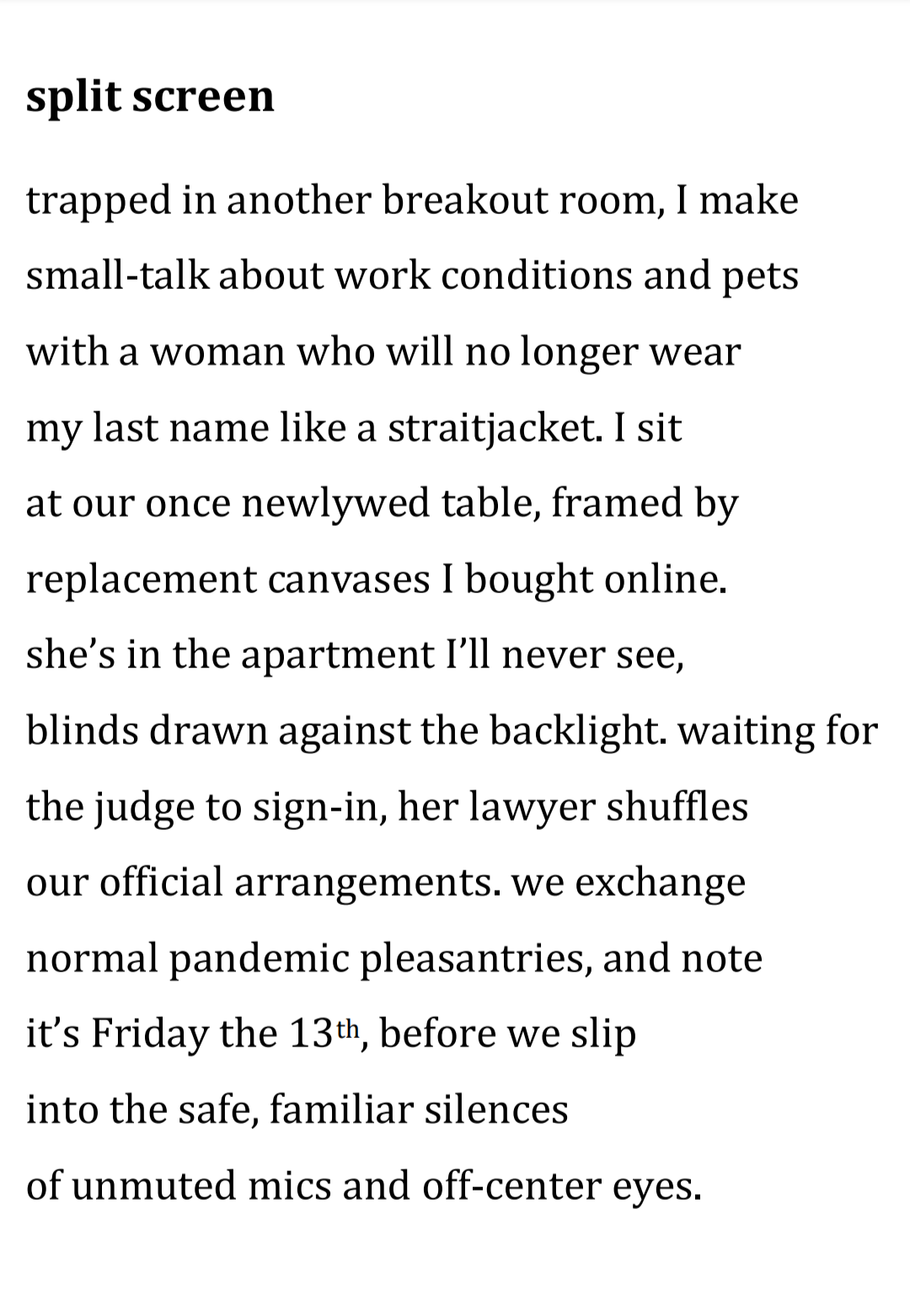


P.S. if you’re a Facebook friend and recognize yourself in this poem, oh well.




Some times people ask me why I don't write love poems. I tell them all my poems are love poems, but I know what they mean. So I show them ones like these two just published in Discretionary Love and they stop asking.
before she began, she placed the glass jar between us—
filled with fresh, golden honey—and a sizable spoon.
homemade. an amateur apiarist, she kept a ready supply.
as she began, I remembered how my mother mixed
honey with lemon, a pinch of salt. a folk remedy
for sore throats, the beginnings of a cold.
when she was through, I asked why. she thought
I meant the amber on the table, not the gaslighting
she called brutal honesty. she said it was to help me
swallow my feelings.
…yet, somehow—
as the scorpion thrashed her pincers
and drowned—the frog survived,
flopped ashore, croaked himself
back to life. a week, a month later,
along the same muddy shore,
another barb-tailed arachnid
implored him for safe passage
across the stream. a ride
atop his slick, perforated back.
it’s not that he doesn’t remember.
it’s just his nature. he never learns.


Featured Interview
I need to give a shout out to Main Street Rag co-founder, Shawn Pavey for his wonderful interview with Matthew E. Henry and one to Matthew as well for his part in making it one of the best interviews Main Street Rag has ever published.
If that’s not enough to get you to turn the page and dive in, let me tell you two things about Teaching While Black by Mr.(Dr.) Henry. First, we knew the day it arrived for consideration that we wanted to publish it. It was a unanimous decision among all readers who just happened to read it at the same time (the wonders of Submittable). Second, as the interview will illustrate, when I read this as a manuscript, I was in the classroom. I was there. The scene was vibrant; the characters alive.
If you have not read Teaching While Black and this interview doesn’t inspire you to want to read this book, your poetic and social soul may well be lost.